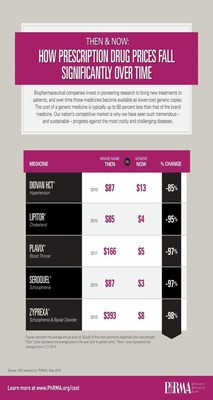
Prescription drug prices fall significantly over time because the marketplace is unlike any other part of the U.S. health care system. Innovator companies invest in pioneering research to bring new treatments to patients, and over time those medicines become available as lower-cost generic copies. Nearly 90 percent of all medicines prescribed to U.S. patients are generics and typically cost up to 80 percent less than the original brand medicine. This is possible because significant research and development resources are not required for the manufacturing of generic medicines.
The impact of generic medicines is widespread and swift. Newly introduced generics are adopted rapidly and can capture an average of three quarters of the market within 3 months, with some capturing as much as 90 percent.
This is one reason why retail prescription medicines have consistently accounted for just 10 percent of U.S. health care spending, even though more than 500 new medicines have been brought to U.S. patients in the past 15 years. The savings created by generic copies free up resources to invest in new treatments - creating headroom for innovation – and resulting in significant progress against some of the most costly and challenging diseases.